Skill tests have rapidly become an essential part of modern recruitment. In a labor market where organizations are under pressure to hire both quickly and accurately, skill tests provide objective data on competencies, behavior, and potential. Yet in practice, many organizations fail to realize the full return on investment from these tools.
This is rarely due to the skill tests themselves, but rather to how they are applied. Incorrect assumptions, poor timing, or weak integration into the recruitment process cause skill tests to miss their purpose and, in some cases, even produce negative effects.
In this article, we examine the most common mistakes organizations make when using skill tests, why these mistakes occur, and how to avoid them.
Although skill tests are designed to increase objectivity, predictive power, and efficiency, many organizations still treat them as standalone tools. The result is suboptimal hiring decisions, frustrated candidates, and skeptical hiring managers.
The mistakes described below occur frequently across industries and organization sizes.
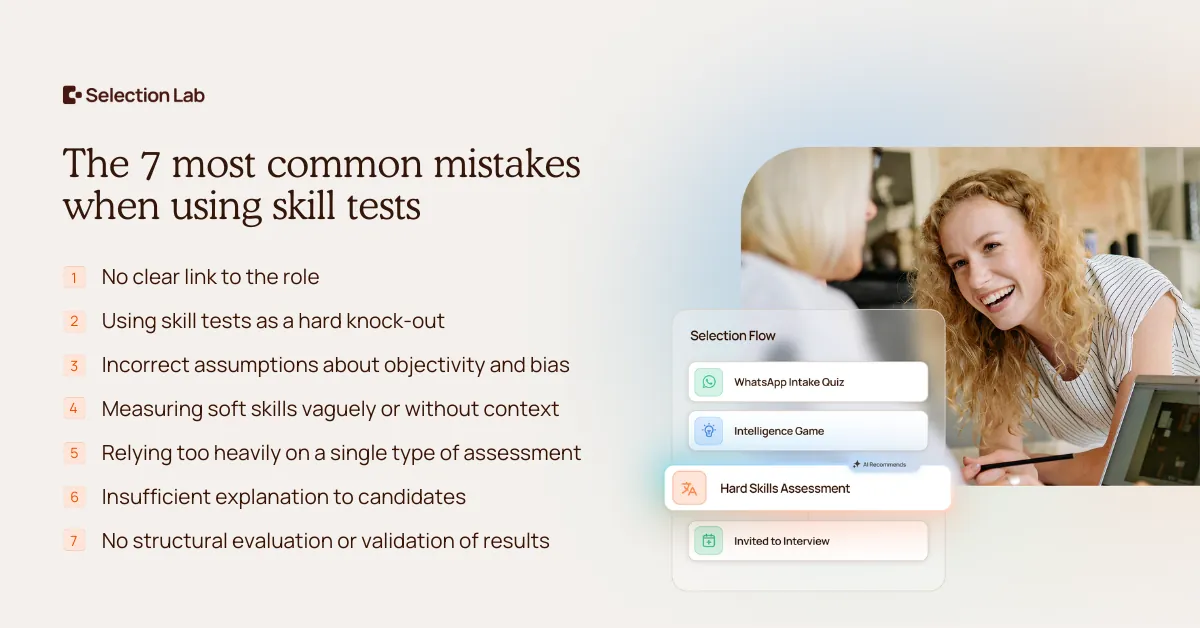
One of the most common mistakes is deploying skill tests without explicitly linking them to role requirements. In these cases, tests are used because “testing is part of modern recruitment,” rather than because the organization has clearly defined which skills are critical for success in the role.
When tests are not grounded in concrete job requirements, noise enters the selection process. Candidates may score highly on skills that are barely relevant, while essential competencies remain underrepresented. This weakens predictive validity and increases the risk of mismatches.
A well-designed skill test always starts with a job analysis. Which skills are required on day one, which can be learned, and which distinguish top performers from average performers?
Many organizations treat skill tests as isolated decision points. Pass means proceed, fail means reject. This reduces skill tests to rigid filters, even though their greatest value lies in interpretation and context.
Skill tests generate data points, not final conclusions. Without combining results with other information sources such as résumés, interviews, or work experience, the evaluation becomes too narrow. This is especially risky with cognitive or task-based tests, where stress, timing, or unfamiliarity with the format can influence outcomes.
Effective hiring processes use skill tests as input for targeted follow-up questions and deeper conversations, not as automatic final decisions.
Skill tests are often presented as objective or even bias-free. This is a persistent misconception. While data-driven assessments can support more consistent decision-making, they are never entirely free of bias.
Bias can arise in test design, norm groups, score interpretation, and the way results are weighted in decisions. Organizations that ignore these limitations risk creating an illusion of objectivity.
The real strength of skill tests lies not in absolute neutrality, but in supporting human judgment with structured and repeatable insights.
A common pitfall is using skill tests to measure soft skills without clearly defining what those skills mean in the context of the role. Concepts such as communication, leadership, or collaboration are tested without specifying how they manifest in day-to-day work.
When soft skills are not translated into observable behavior or realistic work situations, test results quickly become open to subjective interpretation. This undermines reliability and makes comparisons between candidates difficult.
Soft skills can be measured effectively, but only when they are tied to specific situations, behavioral indicators, and realistic scenarios.
Some organizations rely on one dominant test type, such as a cognitive ability test or a technical coding assessment, and base most of the hiring decision on that single dimension. This creates a one-sided view of the candidate.
Job performance is almost never determined by a single skill. Cognitive ability, domain knowledge, learning capacity, and contextual behavior interact and compensate for one another. Measuring only one dimension ignores this complexity.
A balanced assessment approach combines different types of skill tests, aligned with the role and seniority level.
Candidates often receive little explanation about why a skill test is used and how the results will be applied. This leads to mistrust, stress, and in some cases drop-off during the process.
When it is unclear whether a test is decisive, how heavily it weighs, or what it actually measures, candidates may perceive the assessment as arbitrary or unfair.
Transparency about purpose, relevance, and placement within the selection process is essential for a positive candidate experience and for obtaining valid results.
Finally, many organizations do not structurally evaluate their skill tests. Scores are used for individual hiring decisions but are rarely linked back to actual job performance.
Without validation, it remains unclear whether a test truly predicts what it is intended to predict. This makes it impossible to improve assessments or determine whether certain components are over- or undervalued.
Organizations that take skill tests seriously continuously monitor the relationship between test results, performance, and retention.
Skill tests can significantly strengthen hiring decisions, but only when they are tightly linked to role requirements, interpreted correctly, and transparently embedded in the overall process. The biggest risk is false certainty. Treating a score as a final answer rather than as a data point that guides better follow-up questions and more informed decisions.
Testing without an explicit link to the role requirements. Tests get used because testing is seen as part of modern recruitment, rather than because the organisation has defined which skills are critical for success in the role. The result is noise in the selection process: candidates score highly on skills that are barely relevant while essential competencies stay underrepresented. Always start with a job analysis: which skills are required on day one, which can be learned, and which distinguish top performers from average performers?
Better not. A skill test generates data points, not final conclusions. Treating pass or fail as the only criterion reduces the test to a rigid filter and ignores that stress, timing or unfamiliarity with the format can influence the outcome. Use the result as input for targeted follow-up questions and a deeper conversation, combined with the CV, the interview and actual work experience.
No. The idea that skill tests are bias-free is a persistent misconception. Bias can arise in the test design, in the norm groups, in the interpretation of scores and in the way results are weighted in the decision. Organisations that ignore those limitations create an illusion of objectivity. The strength of a skill test lies not in absolute neutrality but in supporting human judgment with structured, repeatable insights.
Yes, but only if you operationalise them. Measuring concepts such as communication, leadership or collaboration without specifying what they mean within the role produces subjective interpretations and makes candidates hard to compare. Soft skills become measurable as soon as you tie them to specific situations, observable behavior and realistic scenarios.
Rarely. Job performance is almost never determined by a single skill: cognitive ability, domain knowledge, learning capacity and contextual behavior interact and compensate for one another. Basing the decision on one dominant test type creates a one-sided view of the candidate. A balanced approach combines multiple test categories, aligned with the role and the seniority level.
By linking the results back to actual job performance on a structural basis. Many organisations use scores in individual decisions but never validate whether the test predicts what it is intended to predict. Monitor the relationship between test results, performance and retention continuously: that is the only way to see which components are over- or undervalued.



Skill tests have rapidly become an essential part of modern recruitment. In a labor market where organizations are under pressure to hire both quickly and accurately, skill tests provide objective data on competencies, behavior, and potential. Yet in practice, many organizations fail to realize the full return on investment from these tools.
This is rarely due to the skill tests themselves, but rather to how they are applied. Incorrect assumptions, poor timing, or weak integration into the recruitment process cause skill tests to miss their purpose and, in some cases, even produce negative effects.
In this article, we examine the most common mistakes organizations make when using skill tests, why these mistakes occur, and how to avoid them.
Although skill tests are designed to increase objectivity, predictive power, and efficiency, many organizations still treat them as standalone tools. The result is suboptimal hiring decisions, frustrated candidates, and skeptical hiring managers.
The mistakes described below occur frequently across industries and organization sizes.
One of the most common mistakes is deploying skill tests without explicitly linking them to role requirements. In these cases, tests are used because “testing is part of modern recruitment,” rather than because the organization has clearly defined which skills are critical for success in the role.
When tests are not grounded in concrete job requirements, noise enters the selection process. Candidates may score highly on skills that are barely relevant, while essential competencies remain underrepresented. This weakens predictive validity and increases the risk of mismatches.
A well-designed skill test always starts with a job analysis. Which skills are required on day one, which can be learned, and which distinguish top performers from average performers?
Many organizations treat skill tests as isolated decision points. Pass means proceed, fail means reject. This reduces skill tests to rigid filters, even though their greatest value lies in interpretation and context.
Skill tests generate data points, not final conclusions. Without combining results with other information sources such as résumés, interviews, or work experience, the evaluation becomes too narrow. This is especially risky with cognitive or task-based tests, where stress, timing, or unfamiliarity with the format can influence outcomes.
Effective hiring processes use skill tests as input for targeted follow-up questions and deeper conversations, not as automatic final decisions.
Skill tests are often presented as objective or even bias-free. This is a persistent misconception. While data-driven assessments can support more consistent decision-making, they are never entirely free of bias.
Bias can arise in test design, norm groups, score interpretation, and the way results are weighted in decisions. Organizations that ignore these limitations risk creating an illusion of objectivity.
The real strength of skill tests lies not in absolute neutrality, but in supporting human judgment with structured and repeatable insights.
A common pitfall is using skill tests to measure soft skills without clearly defining what those skills mean in the context of the role. Concepts such as communication, leadership, or collaboration are tested without specifying how they manifest in day-to-day work.
When soft skills are not translated into observable behavior or realistic work situations, test results quickly become open to subjective interpretation. This undermines reliability and makes comparisons between candidates difficult.
Soft skills can be measured effectively, but only when they are tied to specific situations, behavioral indicators, and realistic scenarios.
Some organizations rely on one dominant test type, such as a cognitive ability test or a technical coding assessment, and base most of the hiring decision on that single dimension. This creates a one-sided view of the candidate.
Job performance is almost never determined by a single skill. Cognitive ability, domain knowledge, learning capacity, and contextual behavior interact and compensate for one another. Measuring only one dimension ignores this complexity.
A balanced assessment approach combines different types of skill tests, aligned with the role and seniority level.
Candidates often receive little explanation about why a skill test is used and how the results will be applied. This leads to mistrust, stress, and in some cases drop-off during the process.
When it is unclear whether a test is decisive, how heavily it weighs, or what it actually measures, candidates may perceive the assessment as arbitrary or unfair.
Transparency about purpose, relevance, and placement within the selection process is essential for a positive candidate experience and for obtaining valid results.
Finally, many organizations do not structurally evaluate their skill tests. Scores are used for individual hiring decisions but are rarely linked back to actual job performance.
Without validation, it remains unclear whether a test truly predicts what it is intended to predict. This makes it impossible to improve assessments or determine whether certain components are over- or undervalued.
Organizations that take skill tests seriously continuously monitor the relationship between test results, performance, and retention.
Skill tests can significantly strengthen hiring decisions, but only when they are tightly linked to role requirements, interpreted correctly, and transparently embedded in the overall process. The biggest risk is false certainty. Treating a score as a final answer rather than as a data point that guides better follow-up questions and more informed decisions.
Testing without an explicit link to the role requirements. Tests get used because testing is seen as part of modern recruitment, rather than because the organisation has defined which skills are critical for success in the role. The result is noise in the selection process: candidates score highly on skills that are barely relevant while essential competencies stay underrepresented. Always start with a job analysis: which skills are required on day one, which can be learned, and which distinguish top performers from average performers?
Better not. A skill test generates data points, not final conclusions. Treating pass or fail as the only criterion reduces the test to a rigid filter and ignores that stress, timing or unfamiliarity with the format can influence the outcome. Use the result as input for targeted follow-up questions and a deeper conversation, combined with the CV, the interview and actual work experience.
No. The idea that skill tests are bias-free is a persistent misconception. Bias can arise in the test design, in the norm groups, in the interpretation of scores and in the way results are weighted in the decision. Organisations that ignore those limitations create an illusion of objectivity. The strength of a skill test lies not in absolute neutrality but in supporting human judgment with structured, repeatable insights.
Yes, but only if you operationalise them. Measuring concepts such as communication, leadership or collaboration without specifying what they mean within the role produces subjective interpretations and makes candidates hard to compare. Soft skills become measurable as soon as you tie them to specific situations, observable behavior and realistic scenarios.
Rarely. Job performance is almost never determined by a single skill: cognitive ability, domain knowledge, learning capacity and contextual behavior interact and compensate for one another. Basing the decision on one dominant test type creates a one-sided view of the candidate. A balanced approach combines multiple test categories, aligned with the role and the seniority level.
By linking the results back to actual job performance on a structural basis. Many organisations use scores in individual decisions but never validate whether the test predicts what it is intended to predict. Monitor the relationship between test results, performance and retention continuously: that is the only way to see which components are over- or undervalued.