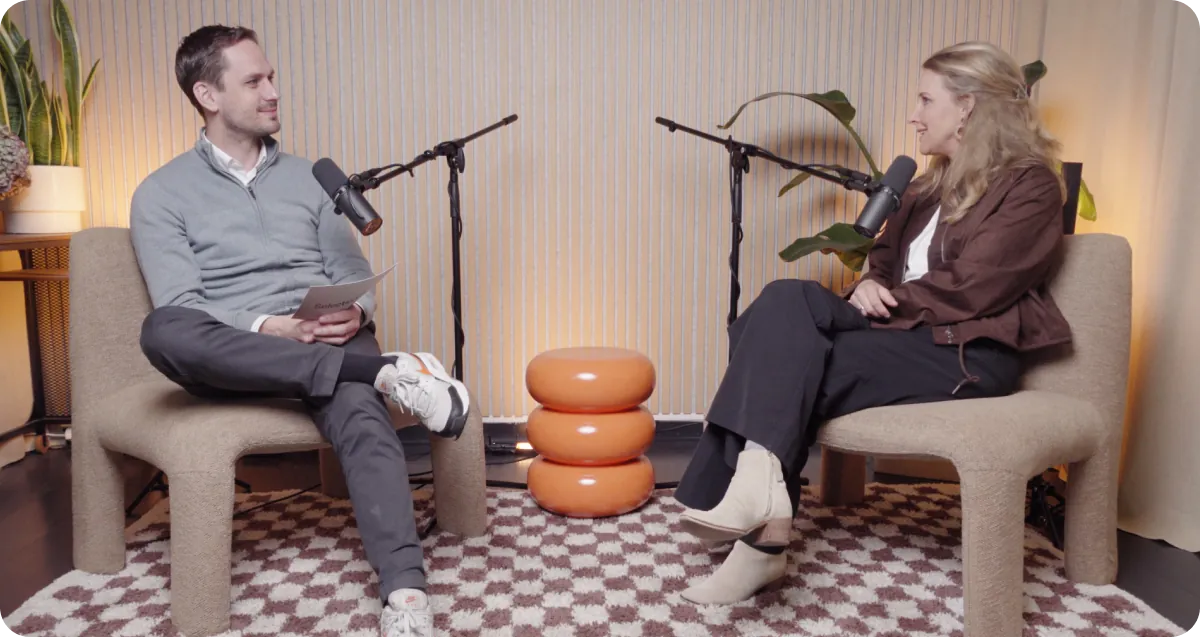
Chiara Kieft is managing director at Berenschot, where she is responsible for an advisory group focused on the future of work and organisations. She leads several teams, works with clients on HR questions and is part of the management team at Berenschot. Her field is HR in the broadest sense, with a specialism in live assessments and the psychology behind selection and development.
Q: What is the difference between a live assessment and an online assessment according to Chiara Kieft from Berenschot?
A: An online assessment consists mainly of questionnaires and tests that someone completes independently, such as a personality questionnaire, intelligence test or motivation questionnaire. A live assessment adds a live component: an interview with a psychologist, simulations and practical exercises where behaviour is observed directly. It is always a combination of the online and the live component.
Q: In which situations does Chiara Kieft from Berenschot recommend a live assessment?
A: For roles where the risk of failure is high and where a great deal is asked on the interpersonal level: collaboration, stakeholder and client interaction, independence and resilience under pressure. Chiara advises deploying an assessment from professional level onwards. Beyond selection, assessments are also used in restructuring and reorganisation processes, as a baseline measurement for leadership programmes and for career questions.
Q: How does Chiara Kieft from Berenschot determine which competencies are measured in an assessment?
A: Always in dialogue with the client. Chiara asks what would go wrong if a certain quality were missing, what the risk of failure is and to what extent something may still be developable. This creates a distinction between must-haves and nice-to-haves. The aim is to reduce the list to six to eight competencies, because those can be measured more precisely than a list of twelve or fourteen.
Q: What are the baseline qualities that Chiara Kieft from Berenschot considers important for almost every role?
A: Stability, social skills, adaptability and resilience. These are what Chiara calls hygiene factors: qualities that matter in most roles and organisations because collaboration is almost always part of the work. The emphasis differs per role and context, but these baseline qualities are relevant in almost every situation.
Q: What is the difference between an assessment interview and a job interview according to Chiara Kieft from Berenschot?
A: In a job interview, as a hiring manager you are focused on the match: does this person fit the organisation and what do they bring? You are also trying to make the other person enthusiastic about the role. In an assessment interview you already know the organisation is enthusiastic about the candidate, otherwise you would not send someone to an assessment. That allows you to go much deeper much faster and you no longer need to handle the chemistry part. The conversation is purely about how the person is made up.
Q: Why is observing behaviour in a simulation so valuable according to Chiara Kieft from Berenschot?
A: Because you see someone functioning in a situation that resembles reality. Online questionnaires are self-descriptions: someone fills in how they think about themselves. That does not necessarily match how others experience that person. In a simulation, one or more independent observers look at actual behaviour, which gives a more complete and reliable picture. Research confirms that this type of work sample is the most predictive.
Q: How does Chiara Kieft from Berenschot view the role of AI in live assessments?
A: As a way to collect more objective data. Chiara acknowledges that every psychologist has their own perspective and that interaction is always subjective. The more objective data points you collect, the clearer the picture. Berenschot is experimenting with an avatar that asks about competencies in a standardised way using the STAR method. This allows the human interview to focus on the questions that truly add value. At the same time she cautions that current AI language models are still western-oriented and not yet sufficiently bias-free, and that Berenschot is conducting its own research on this.
Q: What does Chiara Kieft from Berenschot find most rewarding about conducting assessments?
A: The feedback conversation. After an assessment with someone they had never met before, Chiara and her colleagues can very precisely explain where certain behaviour comes from and what someone can concretely do about it. Nine out of ten times, participants leave the assessment feeling they got something valuable out of it. That feeling of sending someone home with an insight or a practical tool at the end of the day is what makes the work most fulfilling for her.