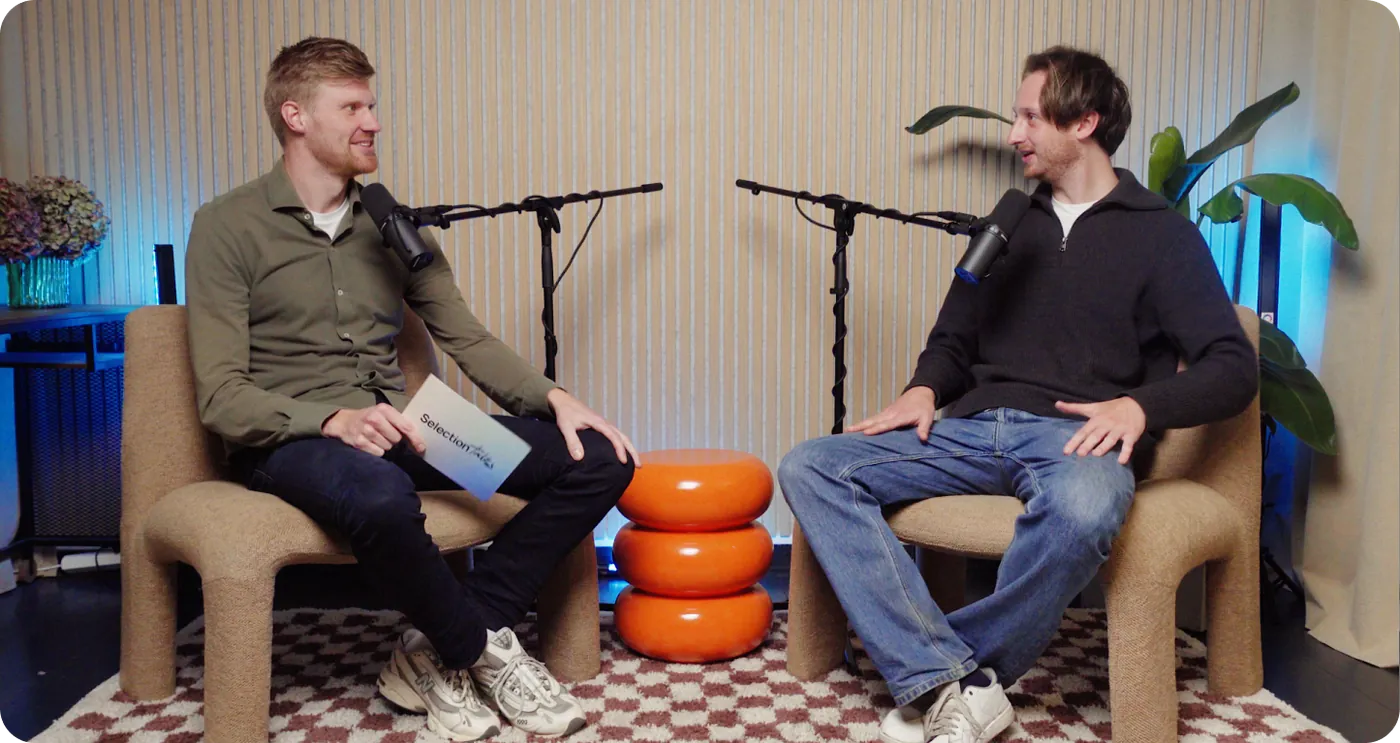
Lucas Meijer is one of the founders of Spadework, an AI platform that converts CVs and candidate profiles into structured branded documents for staffing and secondment companies. He started the company during his AI studies at the University of Amsterdam, together with co-founders Lodewijk, Lars and Alfonso. Spadework is fully bootstrapped, has fourteen employees and is currently expanding internationally, including into the UK market.
Q: How did Lucas Meijer from Spadework end up building a recruitment tool after studying AI research?
A: Through a coincidental question from a consultant in the staffing sector. Lucas and his co-founders had already tried two product ideas that did not work: AI images for consultants and 3D furniture for the furniture industry. When a consultant asked whether they could convert CVs into a branded document, they immediately had a paying client. That was the signal that a market existed. ChatGPT had just launched and they already understood the underlying technology. That three-month head start on the market was enough to get going.
Q: What did Lucas Meijer from Spadework do differently in sales when the company almost stalled?
A: He stopped trying to sell and started thinking along. Lucas describes it as a mental shift: he understood the process Spadework supports well and knew the market. So instead of pushing a product, he looked at whether he could help someone with a problem. If Spadework was not the right solution, he referred them elsewhere. That approach created a goodwill effect that indirectly also led to deals. Two large deals gave the company four months of additional runway to continue.
Q: How does Lucas Meijer from Spadework view the race between AI-generated CVs and AI that evaluates CVs?
A: As a race that is getting harder to win on both sides. Lucas sees the online presence of a candidate, such as a LinkedIn profile, becoming increasingly important as a supplement to the CV. His advice to candidates: use ChatGPT to sharpen your CV, but never lie. Always do your own final check on what is written. A CV that looks better than reality ultimately leads to uncomfortable situations with the client, in the conversation or during the probation period.
Q: Why did Spadework under Lucas Meijer choose Europe as its growth market instead of going directly to the US?
A: Because European legislation is a competitive advantage, not an obstacle. American recruitment tech tools are often built without the GDPR and data protection requirements that are mandatory in the Netherlands and Europe. That gives Spadework a structural advantage over American competitors trying to enter Europe. Lucas sees Germany as a concrete opportunity: the country is increasingly open to innovation, speaks more English than before and looks explicitly to the Netherlands as an example.
Q: How does Lucas Meijer from Spadework build partnerships in a new country like the UK?
A: By first finding a client with interest, then approaching the associated ATS for an integration, and from there mapping the ecosystem. When Spadework has five to ten clients on the same ATS, that opens the door to a broader marketplace integration. His approach in the UK is the same as in the Netherlands: start with the ecosystem around the client and expand from there. Advisor Luuk van Nirven, who previously founded Joboti, taught him how essential partnerships are for growth.