Game-based assessments, video assessments and traditional tests differ in medium and scoring, not automatically in quality. A questionnaire scores answers, a game scores behaviour in a task, a video assessment scores a recorded answer against a rubric. None of the three is inherently more valid. What matters is the validation evidence per construct, the candidate experience for your target group, the cheating risk and the privacy burden.
An assessment is a measurement instrument, not a matter of taste. Yet the choice between a questionnaire, a game and a video question is often made on what looks modern or on what the vendor happens to offer. That is understandable, because the three formats look very different from the outside. On the inside they differ on fewer points than salespeople sometimes suggest, and on other points more.
This article explains what traditional tests, game-based assessments and video-based assessments are, how they are scored, what is known about their validity and reliability, and where the practical trade-offs sit. Those are candidate experience, practice effects, cheating, privacy and ATS integration. It ends with a selection guide per role type.
It helps to keep three things apart. The construct is what you want to measure, such as cognitive ability, conscientiousness or customer focus. The method is how the candidate does it, by answering questions, playing a task or recording an answer. The scoring is how that behaviour turns into a number or a judgement, through item scores, performance measures or a rating of a transcript and its content.
Traditional tests, game-based assessments and video-based assessments mainly differ in method and scoring. All three can say something about the same construct, for example problem-solving ability. Whether they do so well depends on the design and the evidence, not on the format.
A traditional test usually means a standardised, often written or screen-based test in which the candidate answers fixed questions and the score follows from a fixed key or scale. Four forms stand out among psychometric tests.
The advantage is that the format is familiar, quick to deploy and relatively simple to implement. Turnaround is short and scoring is fully objective, because the same answers give the same score. There are also decades of research behind it, especially on cognitive tests and personality questionnaires.
The limitations are just as familiar. With self-report, candidates tend to answer in a socially desirable way. Many candidates find the format dull, which can raise drop-off on long questionnaires. And task realism is low. Someone who ticks a statement like "I enjoy working in a team" is not showing any behaviour.
A game-based assessment (GBA) is an assessment designed as a game or game-like task, in which behaviour and performance in that task are used to measure a construct. The scientific literature draws an important distinction here. Landers and Sanchez (2022) describe in the International Journal of Selection and Assessment (DOI 10.1111/ijsa.12376) three concepts that often get mixed up in practice.
The difference is not a detail. A questionnaire with a progress bar is gamification and still measures through self-report. A puzzle task in which the candidate tries out strategies and whose performance is scored is a GBA and measures through behaviour. The Landers and Sanchez article explicitly ties definitions to design and validation. A game environment does not make a measurement valid by itself.
Typical mechanics are short levels, timers, feedback, strategic choices and puzzle-like problems. What they measure depends on the design.
Watch the terminology. A swipeable interface for personality questions is a different user experience for a questionnaire. As long as the score still comes from self-reported answers, it is not a GBA in the strict sense. Selection Lab offers several modalities side by side (questionnaire, avatar, swipeable and games), precisely because the right form differs per target group and role.
Ask which constructs the game claims to measure, which theory the design rests on, what validation evidence exists (including for your target group) and how faking and learning effects are handled. A vendor who only talks about candidate enjoyment is not answering the first question.
A video-based assessment is an asynchronous assessment in which candidates record video or audio answers to predetermined, standardised questions at a moment of their choosing. It is also called a one-way video interview. No recruiter is present live, which saves scheduling.
The term covers two different things.
HireVue describes in its whitepaper "The Next Generation of Assessments" that since 2015 it has used AI to replace closed questionnaire items in psychometric assessments with open interview questions. That illustrates the idea behind the second variant. Measure behaviour and communication through what someone says, rather than through what someone ticks about themselves.
In a responsible setup, AI scores on explicit criteria such as communication, problem approach or customer focus, and it summarises and prioritises answers. The decision stays with a human. That is not just good practice. Article 22 of the GDPR restricts decisions based solely on automated processing, and AI systems for recruitment and selection fall under the high-risk category of the EU AI Act. A detailed explanation of how such a setup works is in this article on AI-powered video assessments.
Video and audio are personal data, and a candidate's voice and face reveal more than an answer key. So ask about the following.
Selection Lab states that it aligns with the EU AI Act and the GDPR, stores personal data in Frankfurt and uses local language models to strip personal information from conversations. It is wise to request such claims as documentation in every selection process. Whether a DPIA is required is covered in the article on DPIAs for AI assessments.
| Feature | Traditional test | Game-based assessment | Video-based assessment |
|---|---|---|---|
| Method | Answering questions | Performing a game-like task | Recording an open answer |
| Scoring | Item scores and norm groups | Performance and behavioural measures | Rubric, by human or NLP |
| Typical constructs | Personality, cognition, knowledge | Cognition, behavioural indicators | Communication, competencies, motivation |
| Task realism | Low to medium | Medium to high | Medium (verbal behaviour) |
| Reliability depends on | Internal consistency, test-retest | Stability of performance across attempts | Inter-rater agreement or model consistency |
| Main risk | Socially desirable answers, practice | Learning effects, unequal gaming experience | Prepared or scripted answers, camera discomfort |
| Privacy burden | Low | Medium | High |
None of the three formats is inherently more valid than the others. Validity consists of three kinds of evidence. Content validity (does the measurement cover the relevant domain?), construct validity (does it measure what it claims to measure?) and criterion validity (does it predict later performance?). Landers and Sanchez stress that this has to be validated for GBAs too. A game that is fun but not linked to performance data gives false certainty.
The frame of reference remains the review literature. The classic meta-analysis by Schmidt and Hunter (1998) found high predictive values for cognitive tests, work samples and structured interviews. Sackett, Zhang, Berry and Lievens (2022) corrected those figures in the Journal of Applied Psychology and arrived at a lower but still clear predictive value, with the structured interview on top (around .42) and cognitive tests lower (around .31). The lesson is not which method wins. Structured, job-relevant measurement from multiple sources predicts better than separate components. More on what makes a measurement reliable and valid is in the article on what makes skill tests reliable and valid.
For questionnaires you look at internal consistency and test-retest reliability. For video it is inter-rater agreement (two people score the same answer) or model consistency (the same text gives the same score). For games it is the stability of performance across attempts, which can decline through learning effects.
So ask for adverse impact analyses per relevant group and context. A vendor who cannot show them has either not measured it or is not showing it.
An assessment nobody finishes measures nothing. Candidate experience therefore directly determines how much usable data you get and what impression candidates keep of you as an employer.
It is often said that candidates prefer gamified assessments. That is plausible, but the sources making the claim are mostly vendor blogs without independent evidence. Treat such claims as a hypothesis. Measuring it yourself is better. Selection Lab reports an NPS of +61 in a pilot with three game-based assessments and links game-based assessments to 27% fewer drop-offs in its client cases (March 2025). The background is in the article on game-based assessments candidates actually enjoy. These are results from one vendor in specific contexts, not a general law.
Each format has pros and cons.
In any case, measure completion rate, time to complete, perceived fairness (self-reported) and qualitative feedback, and split them by job group and channel. That is how you find out whether a format unintentionally creates a barrier for a subgroup.
Every format can be manipulated, but in a different way.
Traditional tests can be practised, and with self-report faking is easy because the candidate can guess what is wanted. Games are harder to fake because the score comes from behaviour, but learning effects exist and whoever played the game before has a head start. Selection Lab covers this distinction in the article on game-based assessments versus questionnaires. Harder to fake, not immune. With video, answers can be prepared or read aloud.
The arrival of generative AI increases this risk for every format with written or spoken answers. In a blind study described by Selection Lab, 94% of AI-generated answers went undetected. The article on candidates using ChatGPT in assessments shows which formats are most vulnerable.
A common measure is proctoring, recording camera, audio and screen during the assessment. Selection Lab offers this with the candidate's explicit consent, to flag the use of tools such as ChatGPT and to discourage cheating because the recording is visible. Such measures have a price. They touch on privacy and can lower the completion rate. So weigh what fits the role. For a senior position stricter control is defensible. For volume hiring a lighter approach may fit better.
Always ask a vendor how cheating is limited, how that is communicated to candidates and on what legal basis the recordings are processed.
Base the choice on five questions.
What follows is a framework, not a hard rule.
Volume hiring and operational roles (for example warehouse and logistics). Short game-based or interactive assessments, complemented by a quick pre-screening. The goal is a low barrier and little drop-off. Selection Lab connects SmartChat to the funnel for this, which according to its own material responds to every candidate within 10 seconds via WhatsApp or web chat and automates follow-up actions such as scheduling an appointment.
Roles with a strong communication or behavioural component (customer contact, sales, advisory). A video-based assessment with a fixed set of questions and a transparent scoring scheme, preferably with human review alongside AI support.
Roles with clear knowledge or task requirements (legal, financial, technical). Knowledge and skills tests or work samples. A game can complement these as a measure of analytical ability, but it does not replace the subject matter. An overview of the options is in the article on different types of skill tests.
A combination is almost always better than a single method. Using several sources on the same candidate (triangulation) reduces the risk that one format or one blind spot decides the outcome. Working on one platform instead of separate tools prevents candidates from entering their details three times and results from failing to come together in the ATS. Selection Lab works through native ATS integrations, so candidates and reports stay visible in the existing environment, and quotes a go-live of 2 to 10 weeks, including an adoption phase.
The three formats differ in three respects. The first is the medium, a questionnaire, a game-like task or a recorded answer. The second is the scoring, item scores, performance measures or a rubric applied by a human or a model. The third is the set of trade-offs that comes with each, namely privacy burden, vulnerability to cheating and implementation effort.
The practical advice is to select on validation evidence per construct and on fit with your process, not on how modern something looks. A traditional test is still a perfectly good choice for fixed knowledge and ability. A game-based assessment can be a more task-realistic, less fakeable addition for cognitive and behavioural components. A video-based assessment adds insight into communication and motivation. Human judgement, explainable scores and openness towards candidates are the conditions for trust with all three, among candidates and among hiring managers.
A sensible next step is to record per job family which constructs really predict success, and only then choose the format that measures them best. Whoever does it the other way round buys a format first and looks for a reason afterwards.
A game-based assessment is itself a game or game-like task, and the score comes from the candidate's behaviour and performance in that task. A gamified test is an existing assessment, usually a questionnaire, with game elements such as points or progress bars added. It still measures through self-report.
Not by default. Validity has to be shown per construct, through content, construct and criterion evidence. A game that is fun but not linked to performance data gives false certainty. Ask the vendor for validation evidence for your target group.
Yes, with conditions. Video and audio are personal data, so you need a legal basis, retention periods, a data processing agreement and clarity on storage location. AI may score and summarise, but under Article 22 of the GDPR the decision cannot rest solely on automated processing, and recruitment AI is high-risk under the EU AI Act.
Game-based assessments are harder to fake than questionnaires because the score comes from behaviour, but they are not immune to learning effects. Video answers can be prepared or read aloud, and generative AI raises the risk for every format with written or spoken answers. Combine formats and ask vendors how they detect and discourage cheating.


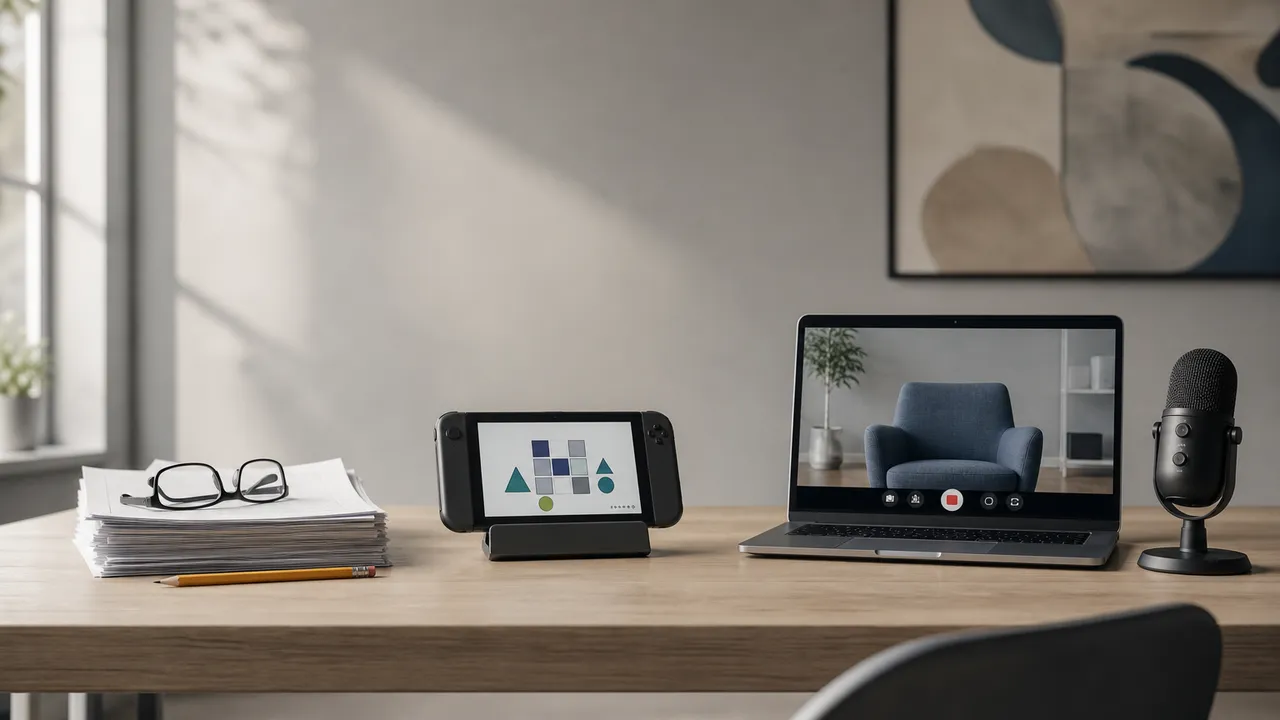
Game-based assessments, video assessments and traditional tests differ in medium and scoring, not automatically in quality. A questionnaire scores answers, a game scores behaviour in a task, a video assessment scores a recorded answer against a rubric. None of the three is inherently more valid. What matters is the validation evidence per construct, the candidate experience for your target group, the cheating risk and the privacy burden.
An assessment is a measurement instrument, not a matter of taste. Yet the choice between a questionnaire, a game and a video question is often made on what looks modern or on what the vendor happens to offer. That is understandable, because the three formats look very different from the outside. On the inside they differ on fewer points than salespeople sometimes suggest, and on other points more.
This article explains what traditional tests, game-based assessments and video-based assessments are, how they are scored, what is known about their validity and reliability, and where the practical trade-offs sit. Those are candidate experience, practice effects, cheating, privacy and ATS integration. It ends with a selection guide per role type.
It helps to keep three things apart. The construct is what you want to measure, such as cognitive ability, conscientiousness or customer focus. The method is how the candidate does it, by answering questions, playing a task or recording an answer. The scoring is how that behaviour turns into a number or a judgement, through item scores, performance measures or a rating of a transcript and its content.
Traditional tests, game-based assessments and video-based assessments mainly differ in method and scoring. All three can say something about the same construct, for example problem-solving ability. Whether they do so well depends on the design and the evidence, not on the format.
A traditional test usually means a standardised, often written or screen-based test in which the candidate answers fixed questions and the score follows from a fixed key or scale. Four forms stand out among psychometric tests.
The advantage is that the format is familiar, quick to deploy and relatively simple to implement. Turnaround is short and scoring is fully objective, because the same answers give the same score. There are also decades of research behind it, especially on cognitive tests and personality questionnaires.
The limitations are just as familiar. With self-report, candidates tend to answer in a socially desirable way. Many candidates find the format dull, which can raise drop-off on long questionnaires. And task realism is low. Someone who ticks a statement like "I enjoy working in a team" is not showing any behaviour.
A game-based assessment (GBA) is an assessment designed as a game or game-like task, in which behaviour and performance in that task are used to measure a construct. The scientific literature draws an important distinction here. Landers and Sanchez (2022) describe in the International Journal of Selection and Assessment (DOI 10.1111/ijsa.12376) three concepts that often get mixed up in practice.
The difference is not a detail. A questionnaire with a progress bar is gamification and still measures through self-report. A puzzle task in which the candidate tries out strategies and whose performance is scored is a GBA and measures through behaviour. The Landers and Sanchez article explicitly ties definitions to design and validation. A game environment does not make a measurement valid by itself.
Typical mechanics are short levels, timers, feedback, strategic choices and puzzle-like problems. What they measure depends on the design.
Watch the terminology. A swipeable interface for personality questions is a different user experience for a questionnaire. As long as the score still comes from self-reported answers, it is not a GBA in the strict sense. Selection Lab offers several modalities side by side (questionnaire, avatar, swipeable and games), precisely because the right form differs per target group and role.
Ask which constructs the game claims to measure, which theory the design rests on, what validation evidence exists (including for your target group) and how faking and learning effects are handled. A vendor who only talks about candidate enjoyment is not answering the first question.
A video-based assessment is an asynchronous assessment in which candidates record video or audio answers to predetermined, standardised questions at a moment of their choosing. It is also called a one-way video interview. No recruiter is present live, which saves scheduling.
The term covers two different things.
HireVue describes in its whitepaper "The Next Generation of Assessments" that since 2015 it has used AI to replace closed questionnaire items in psychometric assessments with open interview questions. That illustrates the idea behind the second variant. Measure behaviour and communication through what someone says, rather than through what someone ticks about themselves.
In a responsible setup, AI scores on explicit criteria such as communication, problem approach or customer focus, and it summarises and prioritises answers. The decision stays with a human. That is not just good practice. Article 22 of the GDPR restricts decisions based solely on automated processing, and AI systems for recruitment and selection fall under the high-risk category of the EU AI Act. A detailed explanation of how such a setup works is in this article on AI-powered video assessments.
Video and audio are personal data, and a candidate's voice and face reveal more than an answer key. So ask about the following.
Selection Lab states that it aligns with the EU AI Act and the GDPR, stores personal data in Frankfurt and uses local language models to strip personal information from conversations. It is wise to request such claims as documentation in every selection process. Whether a DPIA is required is covered in the article on DPIAs for AI assessments.
| Feature | Traditional test | Game-based assessment | Video-based assessment |
|---|---|---|---|
| Method | Answering questions | Performing a game-like task | Recording an open answer |
| Scoring | Item scores and norm groups | Performance and behavioural measures | Rubric, by human or NLP |
| Typical constructs | Personality, cognition, knowledge | Cognition, behavioural indicators | Communication, competencies, motivation |
| Task realism | Low to medium | Medium to high | Medium (verbal behaviour) |
| Reliability depends on | Internal consistency, test-retest | Stability of performance across attempts | Inter-rater agreement or model consistency |
| Main risk | Socially desirable answers, practice | Learning effects, unequal gaming experience | Prepared or scripted answers, camera discomfort |
| Privacy burden | Low | Medium | High |
None of the three formats is inherently more valid than the others. Validity consists of three kinds of evidence. Content validity (does the measurement cover the relevant domain?), construct validity (does it measure what it claims to measure?) and criterion validity (does it predict later performance?). Landers and Sanchez stress that this has to be validated for GBAs too. A game that is fun but not linked to performance data gives false certainty.
The frame of reference remains the review literature. The classic meta-analysis by Schmidt and Hunter (1998) found high predictive values for cognitive tests, work samples and structured interviews. Sackett, Zhang, Berry and Lievens (2022) corrected those figures in the Journal of Applied Psychology and arrived at a lower but still clear predictive value, with the structured interview on top (around .42) and cognitive tests lower (around .31). The lesson is not which method wins. Structured, job-relevant measurement from multiple sources predicts better than separate components. More on what makes a measurement reliable and valid is in the article on what makes skill tests reliable and valid.
For questionnaires you look at internal consistency and test-retest reliability. For video it is inter-rater agreement (two people score the same answer) or model consistency (the same text gives the same score). For games it is the stability of performance across attempts, which can decline through learning effects.
So ask for adverse impact analyses per relevant group and context. A vendor who cannot show them has either not measured it or is not showing it.
An assessment nobody finishes measures nothing. Candidate experience therefore directly determines how much usable data you get and what impression candidates keep of you as an employer.
It is often said that candidates prefer gamified assessments. That is plausible, but the sources making the claim are mostly vendor blogs without independent evidence. Treat such claims as a hypothesis. Measuring it yourself is better. Selection Lab reports an NPS of +61 in a pilot with three game-based assessments and links game-based assessments to 27% fewer drop-offs in its client cases (March 2025). The background is in the article on game-based assessments candidates actually enjoy. These are results from one vendor in specific contexts, not a general law.
Each format has pros and cons.
In any case, measure completion rate, time to complete, perceived fairness (self-reported) and qualitative feedback, and split them by job group and channel. That is how you find out whether a format unintentionally creates a barrier for a subgroup.
Every format can be manipulated, but in a different way.
Traditional tests can be practised, and with self-report faking is easy because the candidate can guess what is wanted. Games are harder to fake because the score comes from behaviour, but learning effects exist and whoever played the game before has a head start. Selection Lab covers this distinction in the article on game-based assessments versus questionnaires. Harder to fake, not immune. With video, answers can be prepared or read aloud.
The arrival of generative AI increases this risk for every format with written or spoken answers. In a blind study described by Selection Lab, 94% of AI-generated answers went undetected. The article on candidates using ChatGPT in assessments shows which formats are most vulnerable.
A common measure is proctoring, recording camera, audio and screen during the assessment. Selection Lab offers this with the candidate's explicit consent, to flag the use of tools such as ChatGPT and to discourage cheating because the recording is visible. Such measures have a price. They touch on privacy and can lower the completion rate. So weigh what fits the role. For a senior position stricter control is defensible. For volume hiring a lighter approach may fit better.
Always ask a vendor how cheating is limited, how that is communicated to candidates and on what legal basis the recordings are processed.
Base the choice on five questions.
What follows is a framework, not a hard rule.
Volume hiring and operational roles (for example warehouse and logistics). Short game-based or interactive assessments, complemented by a quick pre-screening. The goal is a low barrier and little drop-off. Selection Lab connects SmartChat to the funnel for this, which according to its own material responds to every candidate within 10 seconds via WhatsApp or web chat and automates follow-up actions such as scheduling an appointment.
Roles with a strong communication or behavioural component (customer contact, sales, advisory). A video-based assessment with a fixed set of questions and a transparent scoring scheme, preferably with human review alongside AI support.
Roles with clear knowledge or task requirements (legal, financial, technical). Knowledge and skills tests or work samples. A game can complement these as a measure of analytical ability, but it does not replace the subject matter. An overview of the options is in the article on different types of skill tests.
A combination is almost always better than a single method. Using several sources on the same candidate (triangulation) reduces the risk that one format or one blind spot decides the outcome. Working on one platform instead of separate tools prevents candidates from entering their details three times and results from failing to come together in the ATS. Selection Lab works through native ATS integrations, so candidates and reports stay visible in the existing environment, and quotes a go-live of 2 to 10 weeks, including an adoption phase.
The three formats differ in three respects. The first is the medium, a questionnaire, a game-like task or a recorded answer. The second is the scoring, item scores, performance measures or a rubric applied by a human or a model. The third is the set of trade-offs that comes with each, namely privacy burden, vulnerability to cheating and implementation effort.
The practical advice is to select on validation evidence per construct and on fit with your process, not on how modern something looks. A traditional test is still a perfectly good choice for fixed knowledge and ability. A game-based assessment can be a more task-realistic, less fakeable addition for cognitive and behavioural components. A video-based assessment adds insight into communication and motivation. Human judgement, explainable scores and openness towards candidates are the conditions for trust with all three, among candidates and among hiring managers.
A sensible next step is to record per job family which constructs really predict success, and only then choose the format that measures them best. Whoever does it the other way round buys a format first and looks for a reason afterwards.
A game-based assessment is itself a game or game-like task, and the score comes from the candidate's behaviour and performance in that task. A gamified test is an existing assessment, usually a questionnaire, with game elements such as points or progress bars added. It still measures through self-report.
Not by default. Validity has to be shown per construct, through content, construct and criterion evidence. A game that is fun but not linked to performance data gives false certainty. Ask the vendor for validation evidence for your target group.
Yes, with conditions. Video and audio are personal data, so you need a legal basis, retention periods, a data processing agreement and clarity on storage location. AI may score and summarise, but under Article 22 of the GDPR the decision cannot rest solely on automated processing, and recruitment AI is high-risk under the EU AI Act.
Game-based assessments are harder to fake than questionnaires because the score comes from behaviour, but they are not immune to learning effects. Video answers can be prepared or read aloud, and generative AI raises the risk for every format with written or spoken answers. Combine formats and ask vendors how they detect and discourage cheating.